Build Guide
Solar-Powered Repeater
A fully autonomous rooftop or pole node with deeper instruction, more options, and fewer avoidable mistakes
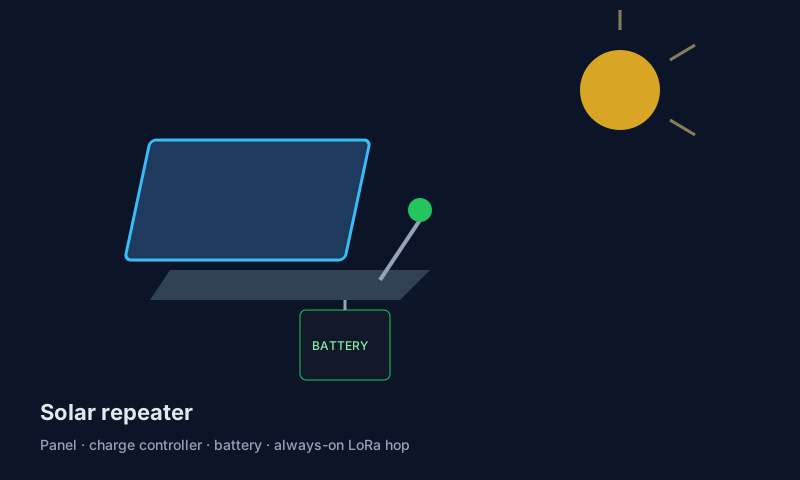
This is the first MilkMesh build that behaves like real infrastructure. You are designing a small off-grid power system, not just bolting a radio into a box. The point is to make a node that survives cloudy days, heat, vibration, and long service intervals without needing wall power.
Learning Goals
- Understand what each part is doing in the power chain.
- Pick hardware based on energy margin, not just convenience.
- Build the enclosure in a serviceable way instead of a one-time tangle.
- Commission the node with an actual checklist before full deployment.
Hardware Selector
RAK WisBlock Starter Kit
The cleanest baseline for solar because its idle and receive behavior are far easier on the battery than many ESP32 boards.
LILYGO T-Echo class devices
Good when you want an integrated low-power node, though enclosure fit and accessory choices can be different from modular WisBlock builds.
ESP32 boards
Use only when you explicitly need WiFi-heavy features and have enough panel and battery margin to support them.
6V 5W mini panel
Good for efficient radios in sunny climates when the node has conservative settings.
6V 10W panel
Worth the size increase if the site has partial shade, poor winter sun, or a board with higher average current draw.
Charge controller choices
TP4056 modules are common and cheap, but a purpose-built solar lithium controller is cleaner if you want a more production-like power chain.
Single protected 18650
The easiest battery path for a modest draw repeater. Use protected cells and a holder, not loose cells with improvised solder tabs.
Two-cell parallel pack
Useful if you expect cloudy streaks or want more safety margin before maintenance visits.
LiFePO4 path
Excellent chemistry for outdoor infrastructure, but it changes the charger and voltage assumptions. Use only if you intentionally design around it.
8x6x4 IP67 box
Enough space for sensible cable loops, standoffs, and future troubleshooting without cramming everything into the lid.
Smaller box
Use only if your layout is proven on the bench. Small boxes punish every later change.
5.8dBi fiberglass antenna
A practical balance of gain, durability, and availability for neighborhood infrastructure.
U.FL to SMA pigtail
Use a short, clean adapter path from the board to a bulkhead or gland exit. Avoid sharp bends near the board connector.
Mounting hardware
Pole clamps or proper brackets usually outlast adhesive-only solutions in real weather.
Inline fuse
Good practice when you are treating the box like actual field infrastructure instead of a hobby prototype.
Voltage test pads
Add a way to quickly probe battery and charging voltage without unmounting the entire node.
Desiccant pack
Helps with condensation in humid climates, but it does not replace good sealing or sensible cable routing.
System Map
Panel
Collects energy during useful sun hours and feeds the charge stage.
Charge controller
Regulates how energy enters the battery and protects against abusive charging behavior.
Battery
Carries the node through night, clouds, and weak-sun days.
Radio + antenna
Turns stored energy into actual network coverage, which is the whole point of the system.
Power Thinking Without a Spreadsheet
Average daily energy needed = node current draw x 24 hours
You do not need to model every electron to make good beginner decisions. You do need a margin. A small efficient node with a moderate panel and a healthy battery is usually better than a power-hungry feature stack on a panel that only works on perfect days.
Build Stages
Stage 1: Bench the power chain before the enclosure
- Lay out the panel, charge controller, battery holder, and radio on the table.
- Confirm panel polarity with a multimeter before landing wires on the controller.
- Confirm battery polarity before connecting the holder.
- Power the radio from the battery side and check that the controller still shows charging behavior when the panel sees light.
Stage 2: Configure the radio for low-drama infrastructure use
Use the bench phase to flash and configure the node before it disappears into the box.
- Set region correctly.
- Give the node a location-based long name.
- Disable extra modules you do not need.
- If using Meshtastic, set an intentional role such as
ROUTER. - If the deployment is fixed, use a fixed position instead of keeping GPS active just because it exists.
Stage 3: Plan the enclosure layout on paper
Before drilling anything, decide where each function lives.
High-current path
Keep battery and charge wiring tidy and mechanically protected.
RF path
Give the antenna feed its own clean route with no hard stress near the board connector.
Service path
Make it possible to open the box later without ripping out the wiring.
Moisture path
Assume water will try to follow the cables. Design for drip loops and sealed entries.
Stage 4: Drill, deburr, dry-fit, then mount
- Mark the gland holes only after the internal layout is believable.
- Drill slowly and clean the edges.
- Dry-fit every gland and cable.
- Mount the electronics using standoffs, adhesive pads, or brackets with enough clearance for airflow and access.
Stage 5: Outdoor commissioning before final permanence
Do one temporary mount first.
- Put the panel in real sun.
- Verify the node remains online through a full day-night cycle if possible.
- Confirm your phone, another node, or your logging workflow can still see it.
- Only then commit to the final rooftop or mast install.
Common Mistakes
Choosing an ESP32 by habit
It works, but it can erase your power margin if you did not actually budget for the higher draw.
Using too little battery
Sunny-day performance is not the test. Cloudy-day survival is the test.
Cramped box layout
Tight layouts look tidy on day one and become miserable on maintenance day.
Panel mounted in shade half the day
A bigger panel cannot fully rescue a terrible site. Choose the site with intention.
Field Notes
Commissioning Checklist
- Panel polarity verified with a meter
- Battery polarity verified before final connection
- Protected lithium cell or intentionally designed pack used
- All cable entries sealed and strain-relieved
- Antenna vertical and mechanically secure
- Node name identifies the actual install location
- One recovery path exists for future maintenance
- Temporary outdoor test completed before final deployment
Checkpoint Questions
Why is a low-power board preferred?
Because every milliamp you do not burn is margin you do not have to buy back with a larger panel or battery.
What is the battery really for?
Carrying the node through darkness, clouds, and weak production periods, not just acting as a wiring convenience.
When should you permanently mount the box?
Only after the bench test and an actual temporary outdoor test both look stable.
What usually matters more than clever accessories?
A sound power budget, good cable routing, and honest site selection.
Next Moves
- Pair this build with Using Mobile Apps with Rooftop Mesh Nodes if you want remote management options.
- Pair it with Mesh Node Monitoring & Data Capture if you want telemetry or MQTT visibility.
- Pair it with Multi-Node Home Mesh Systems if this repeater will anchor a larger household setup.